What Can Go in a Dumpster in Alabama | Dothan Guide
A straight answer from a Dothan roll-off operator: exactly what goes in an Alabama dumpster, what never does, why, and where to take the rest.
ReadDothan, AL guide
An operator's honest breakdown of dumpster pricing in Dothan: what a flat rate should include, which add-on fees to question, and how to pay less.
A fellow out in Kinsey called me in March with a quote from an out-of-town booking outfit. It was eighty dollars under mine, so he took it — I'd have done the same. Three weeks later he called back annoyed, because the card charge had grown by a couple hundred dollars: a fuel surcharge, something called an "environmental recovery fee," and three days of extra rental he never knew he was on the hook for. The box was cheap. The invoice wasn't.
That gap between the quoted number and the settled number is the biggest complaint I hear in the Wiregrass, and it's why I write everything down before a truck leaves the yard on Southport. Dumpster pricing isn't magic. It's four costs stacked together — the truck's time to deliver, the truck's time to pick up, the days you keep the can, and what the landfill charges by the ton to bury what's inside it. Everything else on your invoice is one of those four wearing a different name, or a fee somebody added to make the headline price look smaller.
Below is how the math actually works in Dothan and Houston County, and the questions that will smoke out a padded quote in about ninety seconds on the phone. Every dollar figure here is a range, not a promise — your debris, your street and your dates decide the real number.
When somebody at a locally owned outfit like ours says "flat rate," that number should already have six things baked in before you hang up:
If a quote is missing the tonnage allowance or the rental period, it isn't a flat rate. It's a deposit. Ask for both in a text or an email before you commit. Anybody running a straight shop will send it without blinking.
Bigger cans cost more, but not proportionally — much of the cost is the truck's round trip, and that's the same whether it hauls a 10 yard can or a 30 yard roll-off. Stepping up one size is usually cheaper than the second haul you'll need if you undersize. Our size guide for Dothan homeowners breaks it down by project.
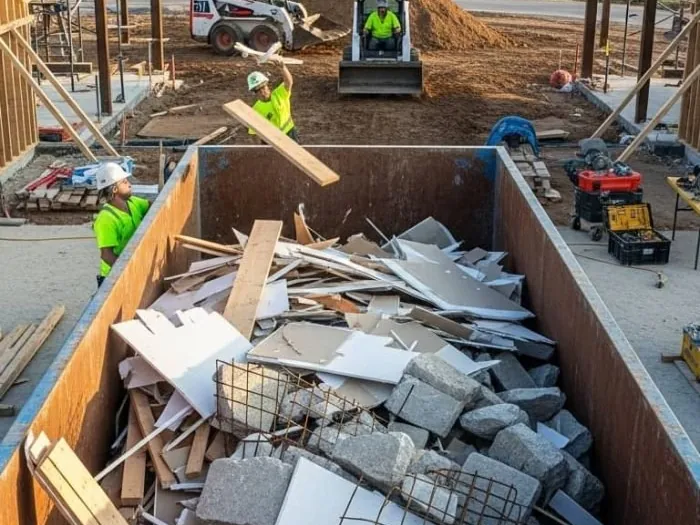
This is the big one, and most people miss it. A 20 yard box full of couches, carpet and closet junk might weigh 2 tons. That same box filled with red clay, brick, or a tear-off from a 1950s ranch off Ross Clark Circle can hit 6 or 8 tons and put the truck over legal axle weight. Heavy material gets handled differently — smaller cans, loaded shallow, priced separately. That's what our concrete and heavy debris service is for. Shingles are dense too, which is why roofing tear-off jobs usually run a 10 or 15 yard can rather than a big one.
Cans that sit aren't earning. Most flat rates cover 7 to 10 days; past that you'll see a daily rate, commonly $8–$20 per day depending on size and season. If your kitchen gut will take three weeks, say so up front — a longer period quoted at the start beats extension days added on the back end.
We're on E Southport, minutes from US-231 and Ross Clark Circle. A drop in Rehoboth, Taylor or Kinsey is a short run. A drop toward Abbeville in Henry County, or down to Columbia on the Chattahoochee, is 30-plus miles each way — an hour of truck time round trip, twice. Honest haulers build that into the flat rate instead of surprising you with a mileage line later. Everywhere we run is listed on our service area page.
Every ton you throw away costs the hauler money at the scale house, and those rates aren't fixed forever. When tipping fees move, dumpster prices move with them. Mixed construction and demolition debris tips at a different rate than clean yard waste or clean concrete, which is exactly why separating material saves you money.
These are ranges, not quotes. Where you land inside a range depends on the debris, the dates and the drive. Call for a firm number.
| Size | Typical use | Typical flat-rate range | What drives the price |
|---|---|---|---|
| 10 yard | Small bath remodel, one-room cleanout, small roof tear-off, concrete or dirt | $300–$450 | Weight, not volume. Fills up heavy long before it fills up full. |
| 15 yard | Two-room remodel, garage clearout, mid-size tear-off, deck removal | $350–$500 | Best size-to-weight balance for mixed remodel debris. |
| 20 yard | Whole-house cleanout, flooring and drywall, storm and tree debris | $400–$575 | Tonnage allowance and how bulky the load is. |
| 30 yard | Large renovation, commercial cleanout, construction jobsite, big estate clear | $500–$725 | Volume plus number of hauls; needs 60+ feet of clear space to set. |
Notice the 10 yard isn't cheap because it's small. It's the box we send for the heaviest work, and weight is what you're really paying for.
Your flat rate includes a set number of tons. Go over it and you pay per-ton overage, commonly $45–$95 per ton in this part of Alabama depending on material. That's not a penalty — it's the scale-house cost passed straight through. What matters is whether the company states the allowance up front and shows you the scale ticket after.
Ask for that ticket. Any hauler weighing loads at a permitted facility gets a printed weight slip, and there's no reason not to share it. Disposal here is regulated by the state's solid waste program — see ADEM. If a company can't produce a ticket for a charge, that's your answer.
The practical way to dodge overage: keep heavy material out of the general box. Concrete, brick, dirt, roofing and plaster from those older in-town homes near the historic district all weigh far more than people guess. Plaster-and-lath fools everybody — one small room's worth can run a ton on its own.
Here's the list I'd read out loud to any company you're comparing. Ask which of these apply, and get the answer in writing:
A lowball number usually means one of three things. The tonnage allowance is tiny — one ton on a 20 yard box, which almost no real load fits inside. The rental period is short, four or five days, so extension days start ticking before your contractor finishes. Or the price came from a national call center that brokers your job to whichever hauler answers, which is how you end up with nobody local accountable when the can doesn't show on the day the framers do. A crew standing around because the box is late costs more per hour than the whole rental.
The same logic scales up. A whole-house estate cleanout costs less when the family pulls donation and scrap metal out before the truck rolls, and a jobsite with a steady debris stream is usually cheaper on a swap schedule than on one oversized box sitting half-full for a month.
Tell me what you're throwing out, roughly how much, where the box is going and what days you need it. That's all it takes for a firm flat quote with the tonnage allowance and rental period spelled out — no fuel surcharge, no mystery fees at the end. We deliver same-day or next-day across Dothan, Rehoboth, Webb, Cowarts, Ashford, Headland, Ozark, Enterprise and the rest of the Wiregrass, and every can goes down on boards so your driveway survives an Alabama summer. Call Big Joey's Dumpster Rental at (334) 336-0388.
Talk to a real person
Call and describe the job. Flat price, stated tonnage, and a delivery time on the same call.
Mon–Sat 7:00am – 6:00pm · Sun by appointment
From this guide
Most residential rentals in Dothan land somewhere between roughly $300 and $725 depending on size, debris type, rental length and how far out of town you are. A 10 yard sits at the low end, a 30 yard at the top. Heavy material like concrete, brick or roofing shifts the number regardless of box size. Call (334) 336-0388 and describe the job for a firm flat quote.
Six things: delivery, pickup, a stated rental period in days, a stated tonnage allowance, fuel, and disposal up to that tonnage. If a quote leaves out the tonnage allowance or the number of rental days, it isn't really a flat rate and the final invoice will likely be higher. Ask for both in writing before you book anything.
You pay a per-ton overage on the amount above your included tonnage, commonly $45 to $95 per ton in this part of Alabama depending on the material. It's the landfill scale cost passed through, not a penalty. Ask to see the scale ticket. Keeping concrete, brick, dirt and roofing in a separate can is the simplest way to avoid overage entirely.
Different tonnage allowances, different rental periods, and different distances from the yard. A drop in Kinsey is a short run; Abbeville or Columbia is 30-plus miles each way, twice. Some companies also quote low then add fuel surcharges and environmental fees at invoice time. Compare the total delivered cost, not the headline number.
Right-size the box so you avoid a second haul, break down cabinets, furniture and fencing so you aren't paying to haul air, keep heavy material like concrete and dirt in its own can, load level with the top rails instead of heaped, and book mid-week during slower months. Having your labor lined up on delivery day also prevents extension-day charges.
Keep reading
A straight answer from a Dothan roll-off operator: exactly what goes in an Alabama dumpster, what never does, why, and where to take the rest.
ReadWhether you need a permit for a dumpster in Dothan comes down to where the container sits. The driveway-versus-street rule, plus HOA and county considerations.
ReadHow C&D debris really behaves in a roll-off: material weights, when to split heavy loads out, sizing by job type, swap-out timing and Wiregrass site logistics.
Read