
Estate Cleanout Checklist: Room by Room in Dothan AL
A practical, unhurried checklist for clearing a family home in the Dothan area: authority first, four piles, where valuables hide, and honest dumpster sizing.
ReadDothan, AL guide
How C&D debris really behaves in a roll-off: material weights, when to split heavy loads out, sizing by job type, swap-out timing and Wiregrass site logistics.
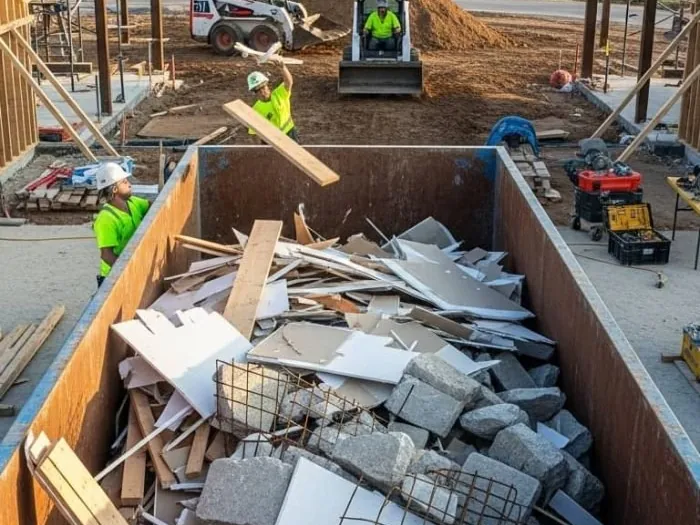
A box full of household junk and a box full of demolition debris look identical from the street. On the scale ticket they are not close. A mixed cleanout — furniture, boxes, bagged clothes, a mattress — runs somewhere around 200 pounds a cubic yard. Gut a 1950s bathroom off Montgomery Highway and the same cubic yard is closer to 700. Same steel, same truck, same driveway. Two and a half to three times the tonnage crossing the scale, and tonnage is what disposal actually charges for.
That gap is the single most useful thing a contractor can understand about renting containers. Volume is what your eye tracks — you look in the box, you see space, you keep loading. Weight is what fills the box in any way that matters. A 20-yard container filled to the rails with broken slab is a truck that legally cannot leave your site. A 30-yard filled with insulation batts and vinyl siding is a truck that could carry three more of them. Most of the money contractors waste on debris is spent in the space between those two facts.
We have been running construction dumpsters across Houston County for long enough to see the same handful of mistakes on repeat: the wrong box for the material, the box placed where the concrete truck needs to be, the box left open on a Tuesday afternoon in July. None of them are complicated. All of them cost real money. Here is how we coach our contractor accounts through it.
Construction and demolition debris is dense, wet-prone, and largely non-divertible once it is mixed. The EPA's C&D materials data puts national generation at more than twice the volume of municipal solid waste, and the bulk of it is the heavy fraction — concrete, asphalt, brick, gypsum, wood. In practical Wiregrass terms: household junk is bulky and light, jobsite debris is compact and heavy, and the older the structure, the worse the ratio gets.
Dothan's in-town housing stock makes this sharper than it is in a lot of markets. Older homes around the historic core and off West Main carry plaster over wood lath, not drywall. They were framed in old-growth longleaf pine that has been drying for eighty years and now hits like a hardwood. Strip a single room to the studs in one of those houses and you have produced more tonnage than a whole new-construction house cleanup out toward Rehoboth or Taylor, where the framing is kiln-dried SPF and the walls are half-inch board.
Print this and stick it in the truck. These are the working numbers we quote from, and they run conservative on purpose because jobsite debris is rarely dry.
| Material | Unit | Typical weight | What that means in a box |
|---|---|---|---|
| Asphalt shingles (3-tab) | 1 square (100 sq ft) | 230–260 lb | About 20 squares per ton |
| Asphalt shingles (architectural) | 1 square | 300–400 lb | 5–6 squares per ton; two layers doubles it |
| Drywall, 1/2 in. | 4x8 sheet | 50–55 lb | ~40 sheets per ton |
| Plaster and wood lath | Per 12x12 room, walls + ceiling | 2–3 tons | One old room can consume a 10-yard box |
| Broken concrete / slab | Cubic yard | 3,000–4,000 lb | 2 cubic yards is a legal truckload |
| Brick and block, loose | Cubic yard | 2,800–3,200 lb | An 8-in. block alone is 32–38 lb |
| Asphalt paving chunks | Cubic yard | 2,700–3,000 lb | Heavy-debris box only |
| Dirt, sandy and dry | Cubic yard | 2,000–2,200 lb | Deceptively heavy at low volume |
| Red clay, damp | Cubic yard | 2,800–3,200 lb | Gains 15–20% after a storm |
| Old-growth pine framing | 16 ft 2x8 | 45–55 lb | Modern equivalent is 30–35 lb |
| Mixed C&D, loose | Cubic yard | 350–500 lb | The number to plan a remodel around |
| Household junk, loose | Cubic yard | 150–250 lb | Why cleanout math never transfers |
Run one example. A 1,900 sq ft ranch getting a full tear-off: roughly 22 squares of architectural shingle at two layers. That is somewhere between 13 and 17 tons before you count felt, ridge, nails and the deck boards you replace. No single roll-off in anyone's fleet handles that in one trip, which is why tear-off jobs are almost always scheduled as a swap, not a rental.
Concrete, brick, block, dirt, sand, asphalt and stone go in a dedicated heavy-debris container, loaded low — usually a 10-yard box filled two to four feet deep and nowhere near the rails. That is not us being precious about equipment. Axle weight limits are legal limits, and a box loaded past them either does not leave or leaves at a cost nobody enjoys.
There is an upside for you. Clean concrete and brick, with no wood, no wire, no trash bags mixed in, goes to a different destination at a different rate than mixed C&D headed for the landfill. Keep it clean and the heavy box is often the cheapest yard of disposal on the whole job. Contaminate it with a few sheets of drywall and a lunch cooler and it gets re-rated as mixed debris. Tell the crew once, on day one, and put a sign on the box if you have to.
On driveway and patio replacements we set both the same morning: one low heavy box for the broken slab, one 20-yard for everything else. The crew never has to think about which is which.
A 10-yard box handles most single-bathroom gut jobs, including tile, an old cast-iron tub and a mud bed. If the walls are plaster and lath, assume the 10 is full and plan a swap.
Cabinets, countertop, flooring, appliances and drywall generally land in a 15-yard box or a 20. Granite and tile push it up; a cabinet-and-counter refresh with no floor work stays down.
A 30-yard container on site with scheduled swaps at demo, rough-in and finish. On older in-town houses expect three or more pulls. Newer construction, usually two.
A 20-yard box is the workhorse. It handles roughly 20–25 squares of architectural shingle within weight, which covers most single-story Wiregrass homes in one pull. Two layers, or anything over 30 squares, means a swap mid-tear-off.
Ceiling grid, carpet, partition studs and old millwork are bulky and light. A 30 is usually right, and the constraint is almost always overnight placement in a shared lot, not weight.
A detached two-car garage with a slab is two boxes: a 20 or 30 for the structure, a low heavy box for the concrete. See our demolition debris page for the sequencing we use.
An idle crew standing around a full box is the most expensive thing on any jobsite. The fix is scheduling swaps against your build sequence instead of reacting when the box is full.
Call the swap at roughly three-quarters loaded, not when it is heaped. Same-day is realistic most weekdays across Dothan and out to Headland, Ashford and Ozark, but a Monday morning slot booked the previous Thursday is a slot you can build a crew schedule around. On a typical renovation the natural swap points are: end of demo, after rough-in and drywall scrap, and at finish-out. Three pulls, three phone calls, no downtime.
Where the box sits determines whether the job runs smoothly for two weeks. A roll-off truck needs a straight approach, roughly 60 feet of clearance to set and pull, and about 23 feet of vertical clearance for the hoist. Low limbs and service drops matter — check overhead before you pick the spot, not while the box is going up.
Put plywood or 2x lumber under the rails on any residential drive. Loaded boxes concentrate serious weight on four small contact points, and Dothan driveways in summer heat are softer than they look. Our driveway protection guide covers the details. On raw ground, remember red clay after a thunderstorm will swallow a truck axle — gravel pad or plated approach, or we set at the road.
Then think about the next three weeks. Keep the box clear of where the concrete truck will spot, off the material drop zone, and out of the framing lumber's path. Moving a full container because it ended up in the pour line is a wasted trip that somebody pays for.
An afternoon storm in July is not weather, it is added tonnage. An open 20-yard box has roughly 150 square feet of opening. Two inches of rain in that box is over 1,800 pounds of water before anything absorbs a drop — and shingles, drywall, carpet, insulation and dirt all absorb plenty. We have seen the same load gain 15 to 20 percent overnight.
Tarp it. A cheap tarp and four bungees before you leave the site is the highest-return five minutes on the job, and it keeps neighbors from donating their own trash after dark.
Beyond the heavy box, clean single-material loads are worth separating when the volume justifies it: untreated wood, scrap metal, cardboard, land-clearing debris. Metal is often worth hauling yourself. Everything else is about keeping mixed-load rates off material that does not deserve them.
Getting debris off the deck is also a safety issue with teeth. OSHA 1926.25 requires that scrap and debris be cleared from work areas and passageways during the course of construction, and protruding nails be removed or bent. A crew that walks debris to a box twice a day trips less and punctures fewer boots. Build cleanup into the last fifteen minutes of every shift and the box does the rest.
Not sure which combination your job needs, or how many pulls to budget? Read our dumpster sizing guide for Dothan, check the towns we cover on our service area list, or just call and describe the job. Joey or one of our dispatchers will tell you straight what fits. Big Joey's Dumpster Rental delivers flat-rate roll-offs across Dothan, Houston County and the Wiregrass, usually same day or next morning, with contractor accounts for crews that need a box on standing order. Call (334) 336-0388.
Talk to a real person
Call and describe the job. Flat price, stated tonnage, and a delivery time on the same call.
Mon–Sat 7:00am – 6:00pm · Sun by appointment
From this guide
Weight, mostly. Broken concrete runs 3,000 to 4,000 pounds per cubic yard, so a 20-yard box would be over legal axle weight before it was a quarter full and the truck could not leave your site. A dedicated heavy-debris box is loaded low, usually two to four feet deep in a 10-yard container, and clean concrete also disposes at a better rate than mixed debris.
A 20-yard box handles roughly 20 to 25 squares of architectural shingle within weight limits, which covers most single-story Wiregrass homes in one pull. If you are tearing off two layers, or the roof is over 30 squares, plan on a mid-job swap. Call with the square footage and pitch and we will tell you whether it is one box or two.
Same-day swaps are realistic most weekdays across Dothan, Rehoboth, Taylor, Headland, Ashford and out toward Ozark and Enterprise. Call when the box is about three-quarters loaded rather than heaped and we will usually have an empty on site before your crew runs out of room. Scheduled swaps booked a few days ahead give you a guaranteed morning slot.
Yes, and it is a common surprise on Alabama jobs. An open 20-yard box has about 150 square feet of opening, so two inches of rain is more than 1,800 pounds of water before absorption. Shingles, drywall, carpet, insulation and dirt soak up plenty more. We regularly see loads gain 15 to 20 percent overnight. Tarp the box before an afternoon storm.
Somewhere the truck can approach straight with about 60 feet of clearance and 23 feet overhead, clear of power lines and low limbs. Put plywood or 2x lumber under the rails on driveways. Then think ahead three weeks: keep it off the concrete pour spot, out of the material drop zone, and clear of the framing lumber's path so nobody has to move a loaded box.
Keep reading
A practical, unhurried checklist for clearing a family home in the Dothan area: authority first, four piles, where valuables hide, and honest dumpster sizing.
ReadSquares, pitch multipliers, shingle weight per layer and a clean sizing table for roof tear-offs around Dothan, plus why a 30-yard box is usually wrong.
ReadNearly all driveway risk lives in ninety seconds of the drop-off and pick-up. Here is what actually causes marks in Dothan, and how to prevent it.
Read