
Home Cleanout Checklist Dothan AL: Room-by-Room Plan
A room-by-room whole-home cleanout plan that Dothan homeowners actually finish: why most stall, the four-zone staging method, dumpster sizing, honest timelines and smarter loading order.
ReadDothan, AL guide
Nearly all driveway risk lives in ninety seconds of the drop-off and pick-up. Here is what actually causes marks in Dothan, and how to prevent it.
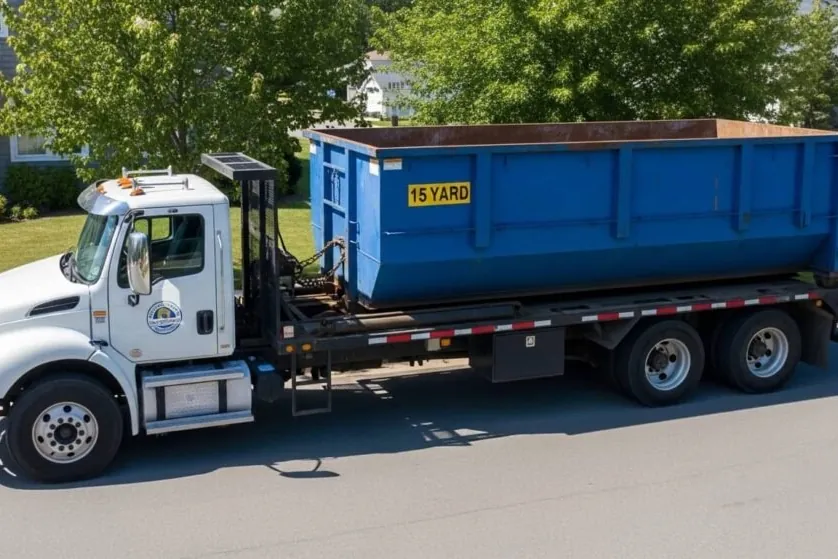
The call we get most often in July doesn't start with "how much." It starts with "is that thing going to tear up my driveway?" Fair question. Somebody has finally decided to gut a back bedroom or strip the shingles off a 1980s ranch inside Ross Clark Circle, and the last thing they want is a gouge down the middle of concrete that has been there since their daddy poured it. After a lot of years setting boxes around Houston County, here is the honest answer: the risk is real, it is small, and nearly all of it lives inside about ninety seconds of the drop-off and the same ninety seconds of the pick-up.
Most people picture the danger wrong. They imagine a heavy container sitting on their slab for a week slowly crushing it. That is almost never what happens. A loaded box spreads its weight along two long steel rails running the length of the container, and concrete handles distributed load beautifully — it is what concrete is for. The trouble comes from point loading: the two rear rollers at the back of the box, each one a narrow steel wheel carrying a big share of the weight through a contact patch about the size of your palm, and the truck's rear axle, which for a moment during the set is parked squarely on your apron with tens of thousands of pounds behind it.
Add one more factor and you have the whole picture. During delivery the container tilts, the rear rollers touch down, and the truck pulls forward while the box settles — that is a rolling motion, not a scraping one, when the driver does it right. Do it wrong, or do it on a surface that has gone soft, and it becomes a drag. On pick-up the winch pulls the box back up the rails and the same rollers travel back across the same stretch of driveway. Two short windows. Everything else is just a heavy object sitting still.
Concrete does not care much about the temperature. Asphalt cares enormously. Asphalt is aggregate held together by bitumen, and bitumen is a thermoplastic — it softens as it heats. On a Dothan afternoon in late July, with the air at 96 and the humidity making it feel worse, a dark asphalt drive in full sun can easily sit thirty to fifty degrees above air temperature. At that point the surface is genuinely pliable. Press a kickstand into it and it sinks. Now put a steel roller on it.
This is the single highest-risk moment in the whole job, and it is entirely avoidable. A container set on the same driveway at 8:00 in the morning, before the sun has had six hours to work on it, behaves like a totally different surface. We schedule around this on purpose from June through September. If you have asphalt and you are booking in summer, ask for a morning slot. It costs nothing and removes most of the risk.
Concrete has its own weak points, they are just different ones. Older in-town driveways off Montgomery Highway or in the neighborhoods around Westgate often have hairline cracking, a pecan or water oak root lifting one panel, and an apron at the street that thins out to two or three inches at the edge. Newer subdivision drives out toward Rehoboth and Taylor are usually thicker and in better shape, but they frequently come with a stamped or decorative section, or a paver band at the sidewalk, and those are a different problem again.
| Surface | Risk during set and pick-up | What we do about it |
|---|---|---|
| Sound concrete, 4 inches or better, good subgrade | Low | Planks under the rail and roller contact points as standard |
| Older in-town concrete with hairline cracks or root heave | Moderate | Full plank run, set over the thickest panel, stay off the joints |
| Asphalt, cool months (roughly November to March) | Low to moderate | Planks under rollers, slow set, no wheel turning while stopped |
| Asphalt, summer afternoon in direct sun | High | Move to a morning slot, or plywood over planks, or relocate |
| Stamped concrete, decorative finish, paver apron | High | We do not place on it — we set past it or use the street |
| Gravel or packed dirt farm drive, dry | Low | Usually nothing needed; we pick firm, level ground |
| Gravel, sand or clay drive after heavy rain | Moderate to high | Reschedule, or set near the road where the base is compacted |
| Lawn or turf | Varies wildly | Only when the ground is genuinely dry and firm, on plywood |
Boards are not a gimmick and they are not an upsell. Two-by-tens or lengths of three-quarter plywood laid where the rollers touch down and where the rails come to rest spread that concentrated load across a much wider footprint. It is the same principle as snowshoes. We carry them on every truck and we use them by default on residential driveway jobs whether you ask or not.
Flattest and thickest section, every time. That usually means the middle of the drive rather than the apron at the street, because the apron is where slabs are thinnest and where the subgrade has been disturbed by utility work. Keep the rollers off expansion joints and control joints — a joint is a deliberate weak line, and a point load right on it is asking the slab to crack where you told it to. Never straddle a drain grate, a water meter lid, a clean-out, or a septic tank access cover. Those lids are rated for foot traffic and a lawnmower, not six tons.
The driveway gets all the attention. These are the things that actually generate the phone calls:
Size matters here too. A 10-yard container is shorter, lighter and far easier to place on a tight in-town drive than a 30. If you are loading anything genuinely heavy — brick, block, tile, dirt — a small box is not just cheaper to haul, it is kinder to your slab. Our guide to choosing a dumpster size in Dothan walks through it, and concrete and heavy debris loads have their own rules.
Sometimes it is. Street placement is a genuine option on many residential streets, though it may involve the city and it changes what you need to think about — read our Dothan permit rundown before you commit to it. A gravel pad, a farm turnout or a compacted shoulder is often the best surface on the property. Lawn placement works when the ground is truly dry and firm, and is a bad idea in the week after a summer storm when the red clay is still holding water.
Walk the drive once the box is gone. You are looking for three things: a shallow indentation where a roller sat, a scuff or black scrape mark, and any fresh crack running from a joint. Scuffs on asphalt often close up on their own with a few hot days and a broom. Real damage is rare, and a reputable company deals with it plainly — you call, someone comes and looks at it in person, and it gets sorted out. Ask who you are dealing with before you book, not after.
Which brings us to the last point. A driver who spends five extra minutes walking the drive, laying boards and repositioning by two feet is worth considerably more than a quote that is twenty dollars cheaper. That is a philosophy, not a marketing line, and it is the reason we run the routes we run across the whole Wiregrass service area.
Tell us about your driveway and we will tell you honestly how we would set it — including the times we would recommend the street or a gravel pad instead. Call Big Joey's Dumpster Rental at (334) 336-0388 and ask for a morning placement if you have asphalt and it is summer. We will bring the boards.
Talk to a real person
Call and describe the job. Flat price, stated tonnage, and a delivery time on the same call.
Mon–Sat 7:00am – 6:00pm · Sun by appointment
From this guide
It is unlikely on sound concrete. A container spreads its weight along two long rails, which concrete handles well. The real risk is point loading at the rear rollers during the drop-off and pick-up, and at the truck's rear axle. Planks under the roller contact points, plus placement on the thickest panel away from joints, removes most of that risk.
Yes, but timing matters more than anything else. Alabama asphalt softens badly in direct afternoon sun and a steel roller can leave an impression in it. Book a morning slot from June through September, before the surface has heated up. We also lay boards, and on a marginal drive we will suggest the street or a gravel pad instead.
Clear the driveway completely, including vehicles, boats and trash cans. Measure the width between gate posts and check overhead clearance for limbs and power lines. Mark your septic lid, sprinkler heads and any shallow utilities. Decide the exact spot, mark it, and sweep grit off the landing area. Then tell the dispatcher about slope, soft ground or anything unusual.
Both work under the right conditions. Dry, firm turf on plywood is fine for a short rental. Gravel and packed dirt drives are often the best surface on a rural property. What causes trouble is sandy or red-clay ground after heavy rain, when a loaded truck ruts badly. In that case we would rather reschedule than leave you with tracks.
Call us. Someone comes out and looks at it in person rather than arguing over photographs. Light scuffs on asphalt frequently disappear on their own after a few hot days. Genuine damage is rare, and we are licensed and insured for a reason. Walk the drive after pick-up and let us know the same day if you spot something.
Keep reading
A room-by-room whole-home cleanout plan that Dothan homeowners actually finish: why most stall, the four-zone staging method, dumpster sizing, honest timelines and smarter loading order.
ReadAn honest Wiregrass operator's guide to where your load really goes, why weight sets the price, and the correct destination for everything a dumpster can't take.
ReadA straight-talking guide to picking between a 10, 15, 20 or 30 yard roll-off in Dothan, with real dimensions, weight limits and worked job examples.
Read